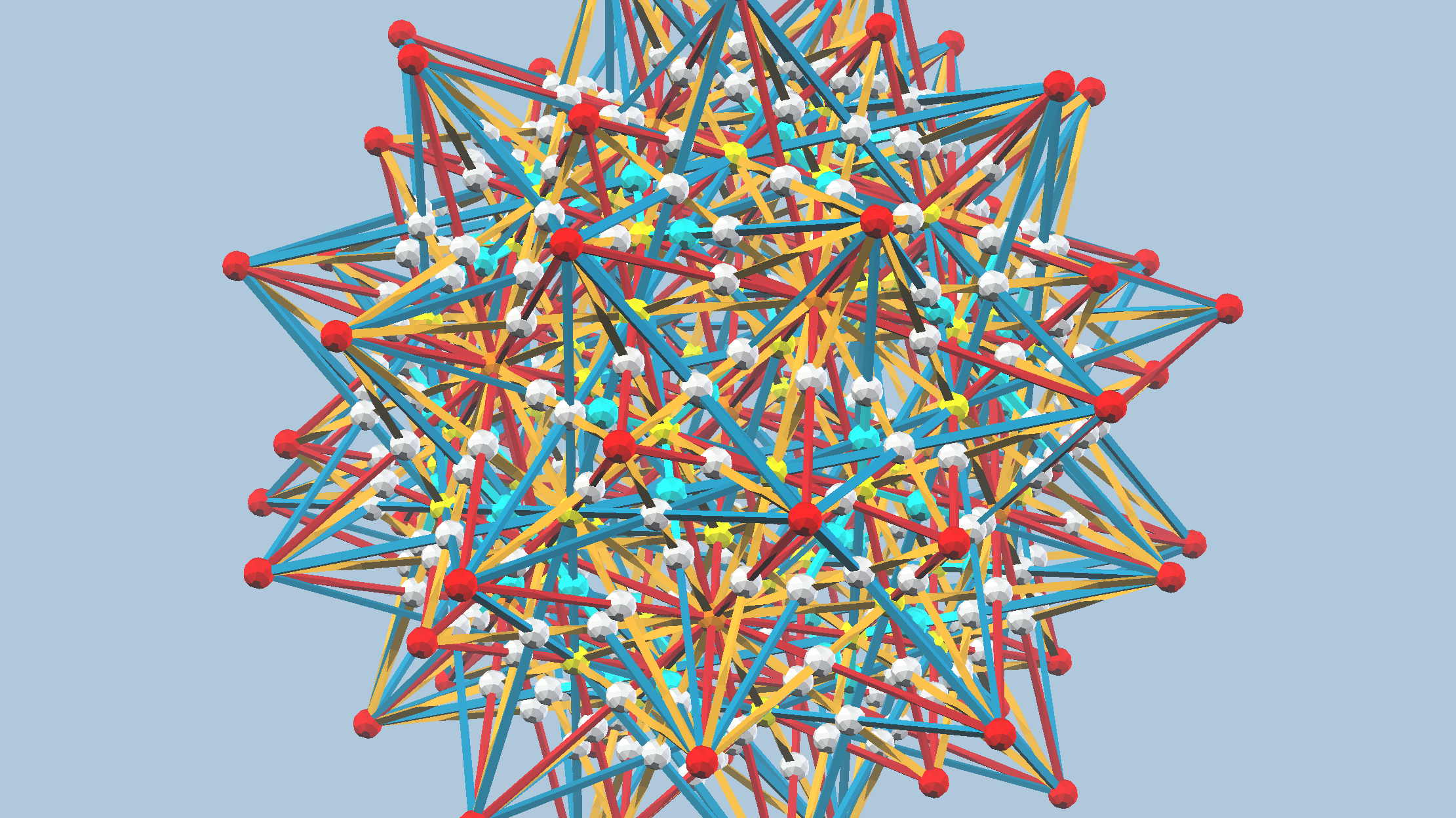
The icosahedral projection of an assembly of 600 regular tetrahedra in 4-dimensional space, arranged so that each edge is shared by 5 tetrahedra, now with the great icosahedron as vertex figure (David Richter). This model alse represents the projections of three other regular star polychora that share its edge arrangement (Paulo Freire). As all star polytopes, it has full hexacosichoric symmetry. On the outside of the model, an undistorted great icosidodecahedron can be seen. Its dual is the great grand stellated hecatonicosachoron.
The model could be constructed by building two concentric hexacosichora at scale 1 and φ respectively, and extending the edges of the inner to the vertices of the outer.
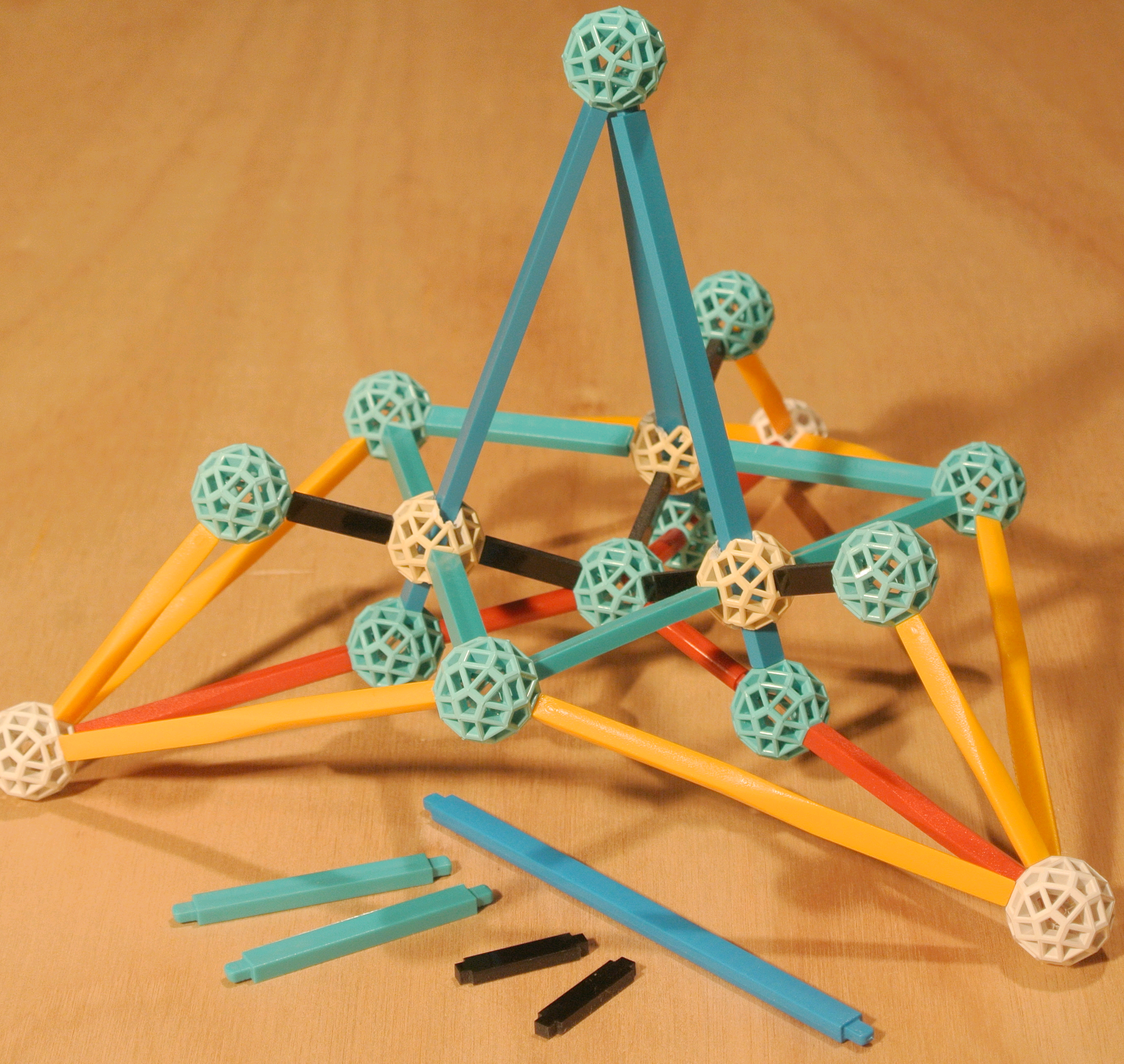
In this vZome model, the vertices of the inner hexacosichoron are coloured yellow and the vertices of the outer are coloured red. Vertices belonging to both are coloured orange. Each teal ball should connect one hb0, two hb1's, two hb2's and one hb3. In the physical implementation, one can take advantage of a prismatic connector. Such a connector has only 3 pairs of opposite rectangular holes: two pair of holes at the side are regular Zometool holes, able to fix any (half-)length blue strut, and through holes at the bases, any (full-)length blue can be passed. A prismatic connector is introduced in step 6 of the step-by-step instructions, connecting one hb1 and two hb2 struts: