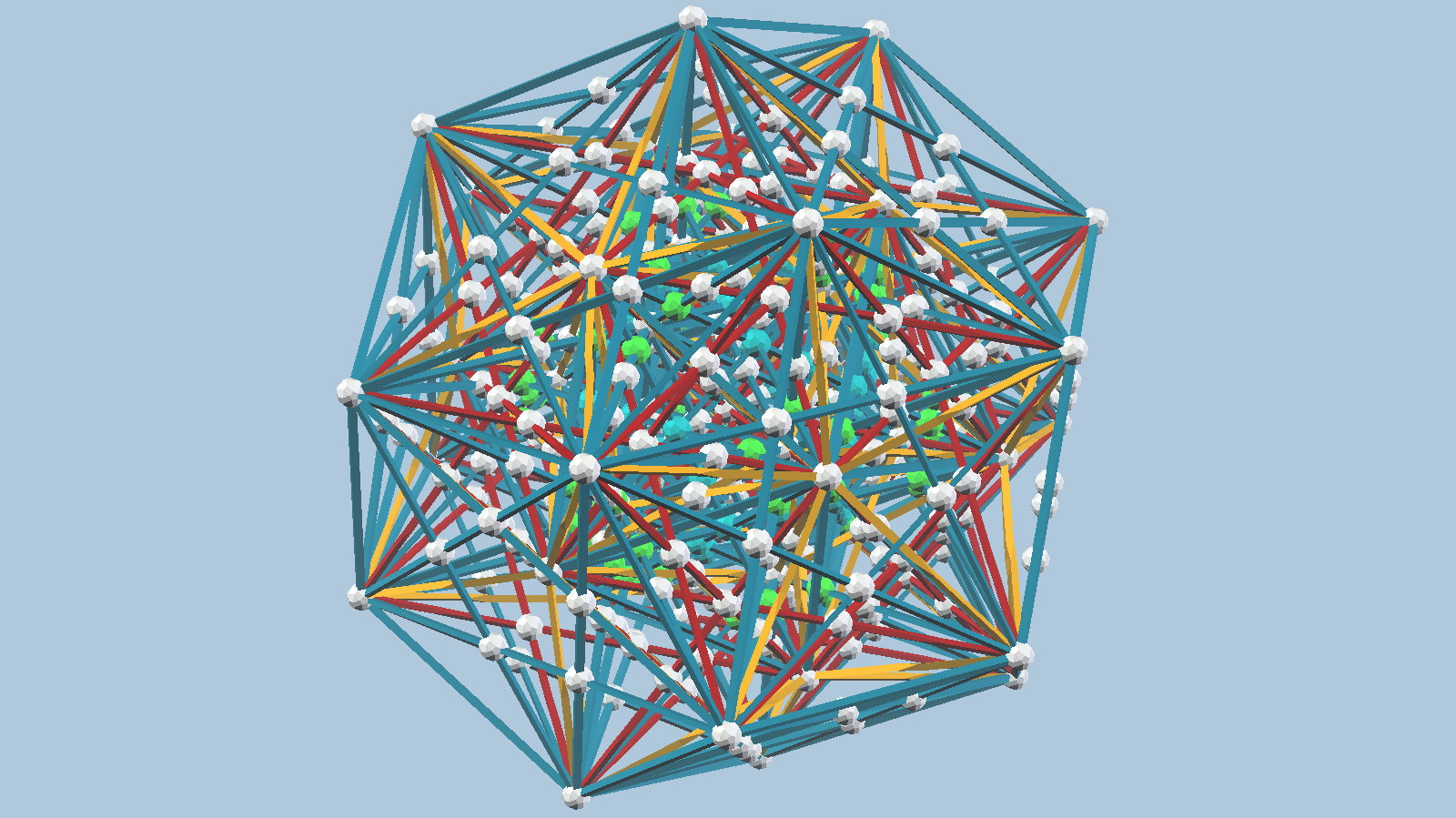
Scott made a vZome model of the Gosset’s 3_21 polytope. I could not neglect his remark Constructing this in real Zome would be a real challenge!. Therefore a perl script cleaned up his model a bit by eliminating all (partially) overlapping struts and by replacing all crossing full-length struts by connecting half-length struts. Unfortunately, for the actual physical build, Zometool hb1 struts have not been produced commercially. At first I made some compromises to build a approximate Zometool model: in between the teal and pink connectors, I simply dropped the required hb1 struts, and for the blue struts emanating from the pink connectors I used a b2 bending over a b1, instead of 2hb2’s connected to 2hb1’s.
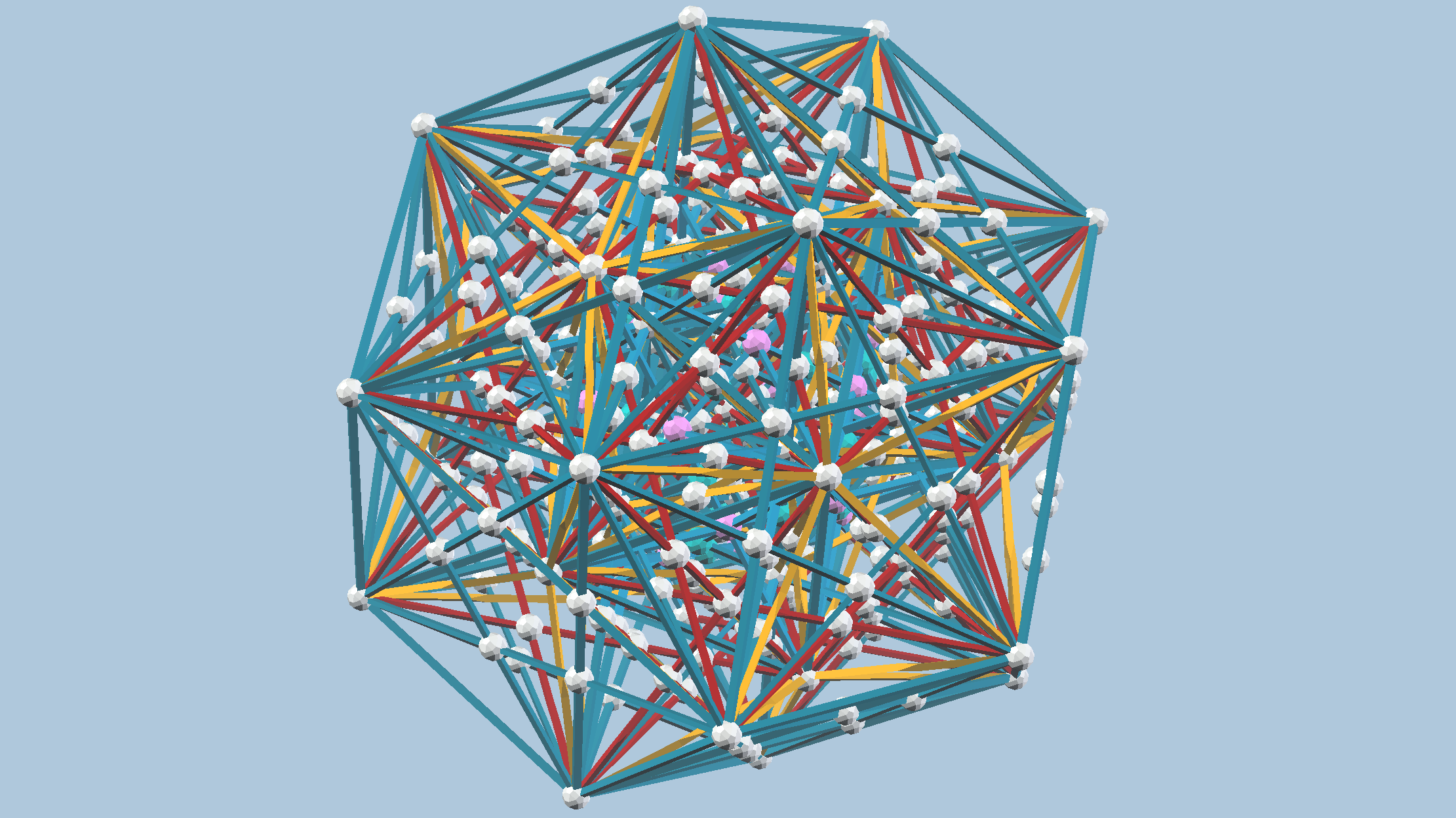
That was a very bad idea. Bending b1 and b2 struts produced a distorted model where a lot of the outer edges do not fit anymore. Moreover during the building process many struts were falling out and had to be reinserted again and again. If one want to model crossing edges with Zometool, one has three options:
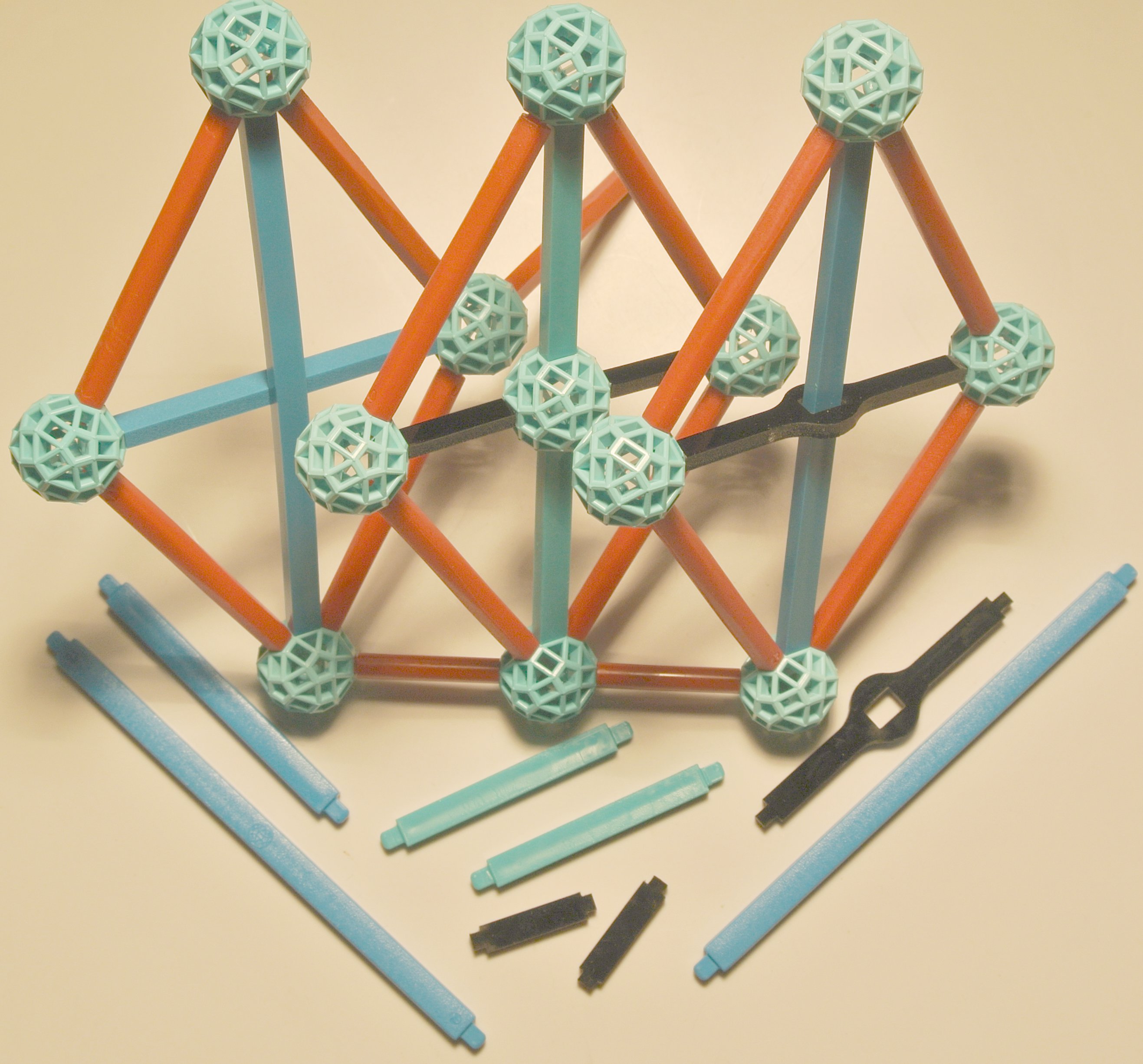
Either one forces struts to bend over other struts (on the left of picture), which I cannot recommend, unless for length 3 struts. A much better option introduces half-length struts meeting in an additional connector (in the middle of picture). The best option (on the right of picture) introduces modified full length struts with a hole, through which another strut can pass without bending. Both option are implemented in my second build of Gosset’s 3_21 polytope. As I did not have a 3D printer at my disposal, both the hb1 struts and the b1 struts with a hole have been lasercutted in black acryl. In the resulting model the black b1 struts with a hole constitute the edges of a dodecahedron with pink vertices. The normal blue b2 struts passing through the holes are the edges of the dual isosahedron. The green Zometool balls connect two black hb1 struts and two teal hb2 struts. Now a physical model is obtained without distortions, and without having to endure problems during its construction.