Robert Webb increased the genus from the Cupola Drilled Truncated Icosahedron from a mere 11 to 41. Much earlier, Bonnie Stewart used a more direct approach to reach a similar result. A Cupola Drilled Truncated Icosahedron has 30 pairs of parallel square faces (coloured blue in the folowing vZome model). If one succeeds in drilling a hole for each pair of squares, bounded by a sequence of regular polygons with the same edge length, one would obtain a Stewart toroid of 41.
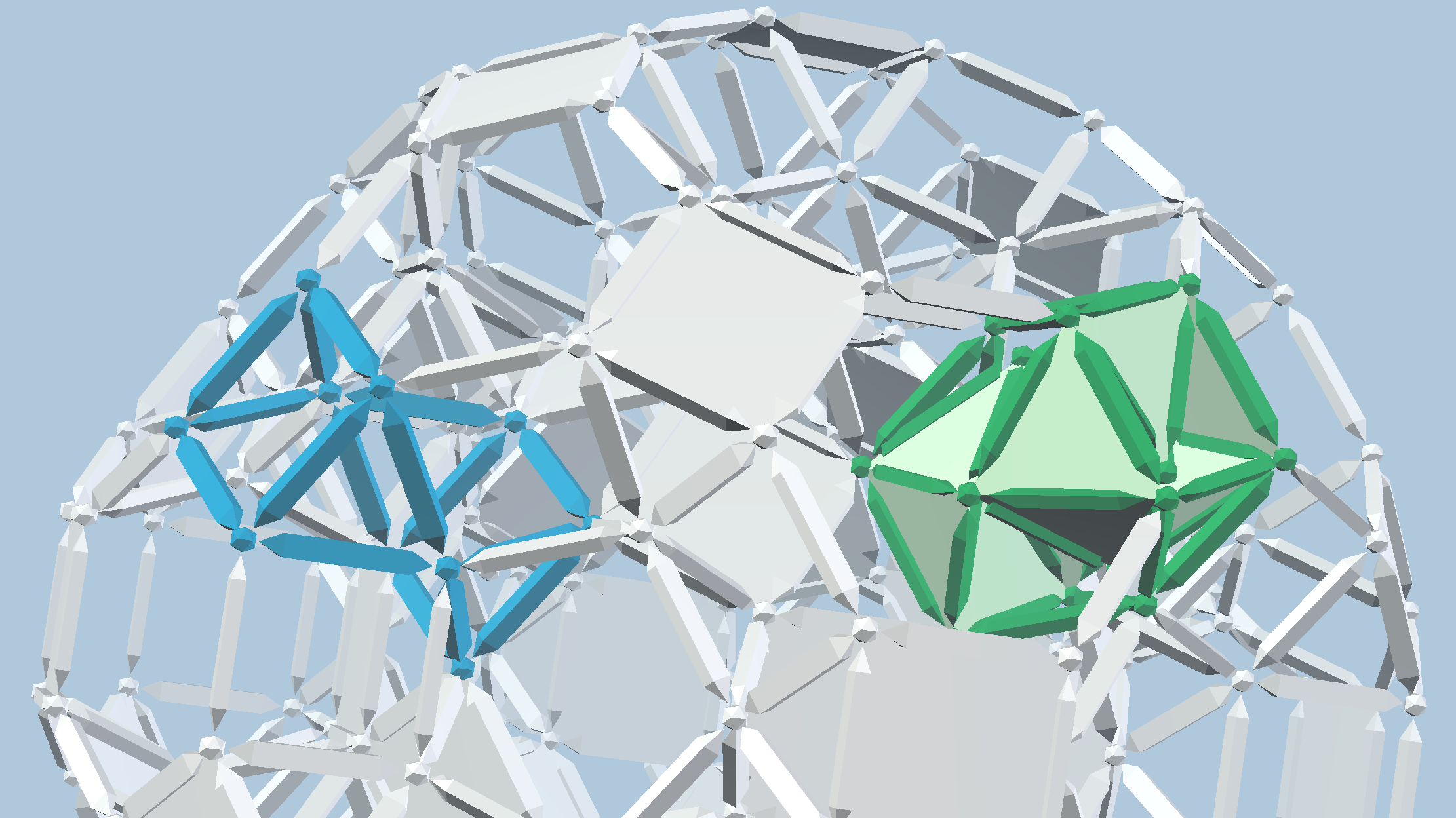
A pair of squares in a Cupola Drilled Truncated Icosahedron exactly matches a pair of squares in a Bilunabitorunda. Therefore the hole can exactly be drilled as in a Drilled-Bilunabirotunda, using Z4’s. This object is coloured green in the vZome model. Many of the edges of such a construction do not belong to the blue Zome orbit. Hence, for the most part it is 3D printed, monolitically with its panels. Actually, it is printed in two halves, held together with four Zometool balls, to reduce the need for elaborate supports.
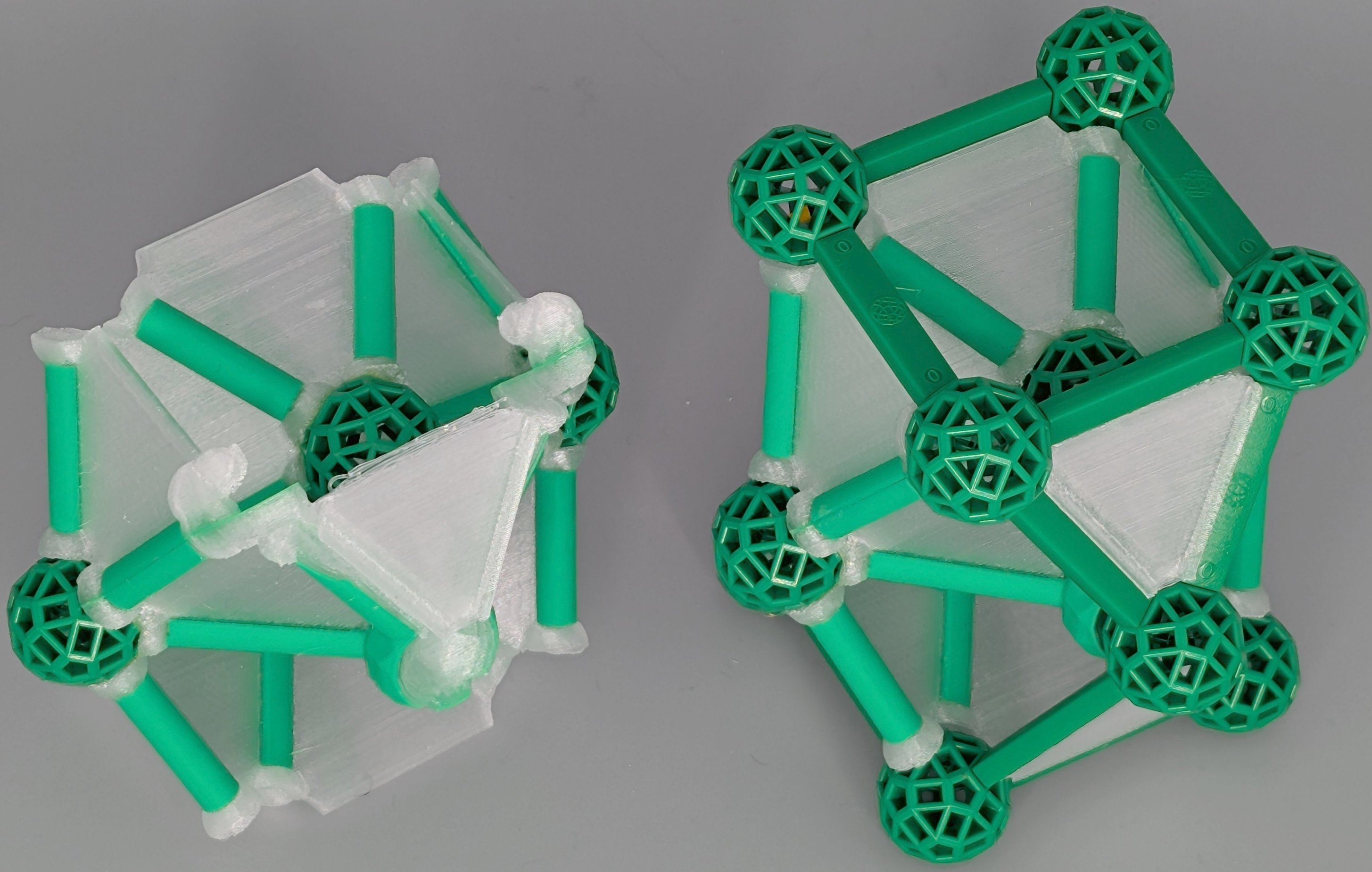
Using these prefab tunnels, building a physical model is rather straightforward:
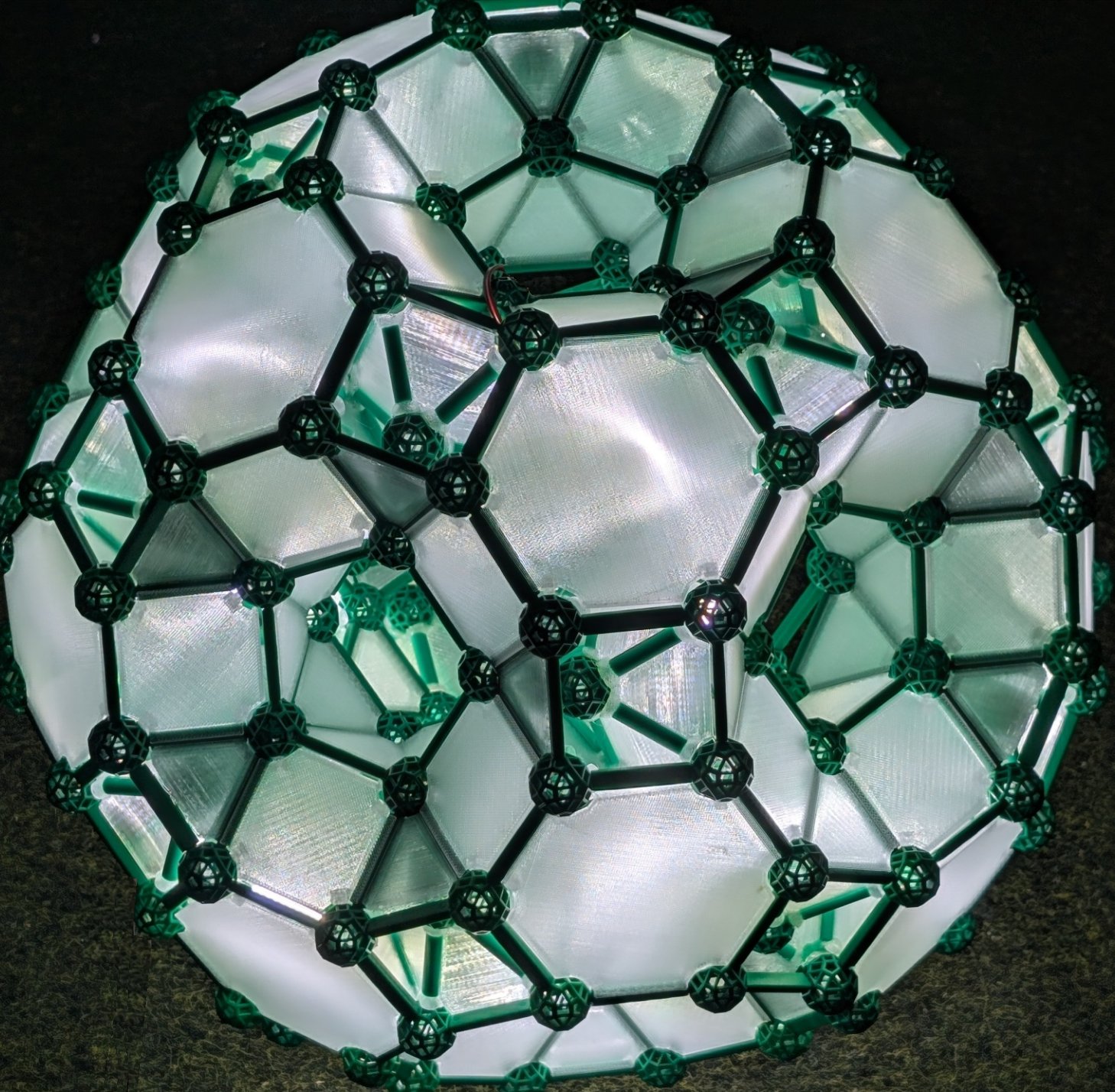
This Stewart Toroid has genus 41, which can be verified by:
genus = 1 + (#edges-#vertices-#faces)/2 → 1+(1380-420-880)/2 = 41
The Z4 tunnels not only provide for 30 additional holes: they also guarantee that the solid body of the toroid stays connected. The tunnel object may be rotated by 180°, but not by 90°, otherwise the passage inside the solid body around the tunnels would be blocked. A flight through tries to illustrate this: in the first part of the video, the camera stays in the body under a hexagonal panel, and peeks into the pathways towards a neighbouring similar part. In the second part of the video, the camera makes a complete roundtrip around a pentagonal hole, slalomming around the five Z4 tunnels between the square faces.
The solid body of the Genus-41 Toroid is bounded by an outer Rhombitruncated Icosidodecahedron and an inner Rhombicosidodecahedron. The following photo, illuminated by a LED strip put into the solid body, emphasises this.
The next photographs show pictures from within the Rhombicosidodecahedron: the first illuminated by an external source (the sun), the second by a LED strip put into the solid body.
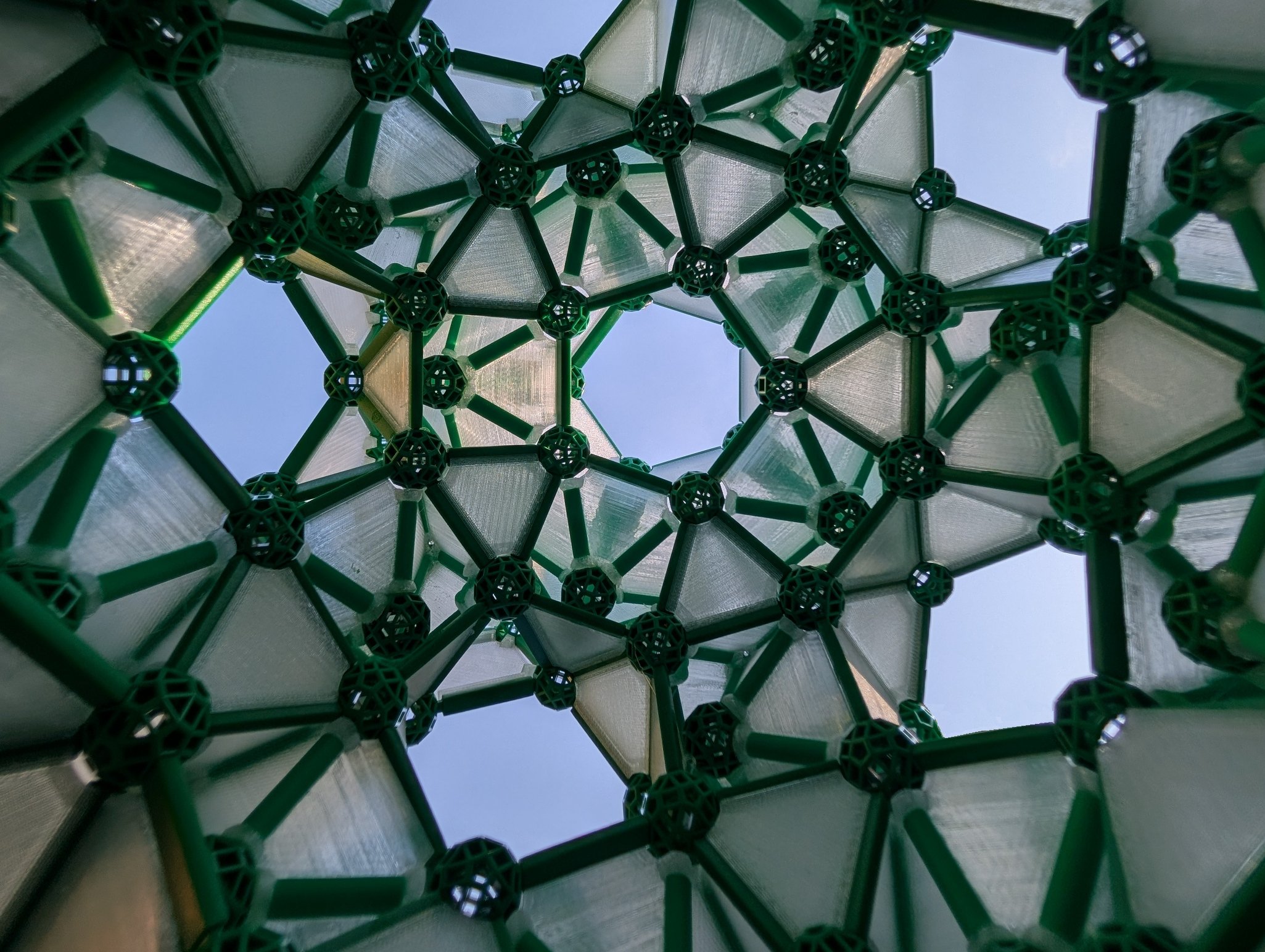
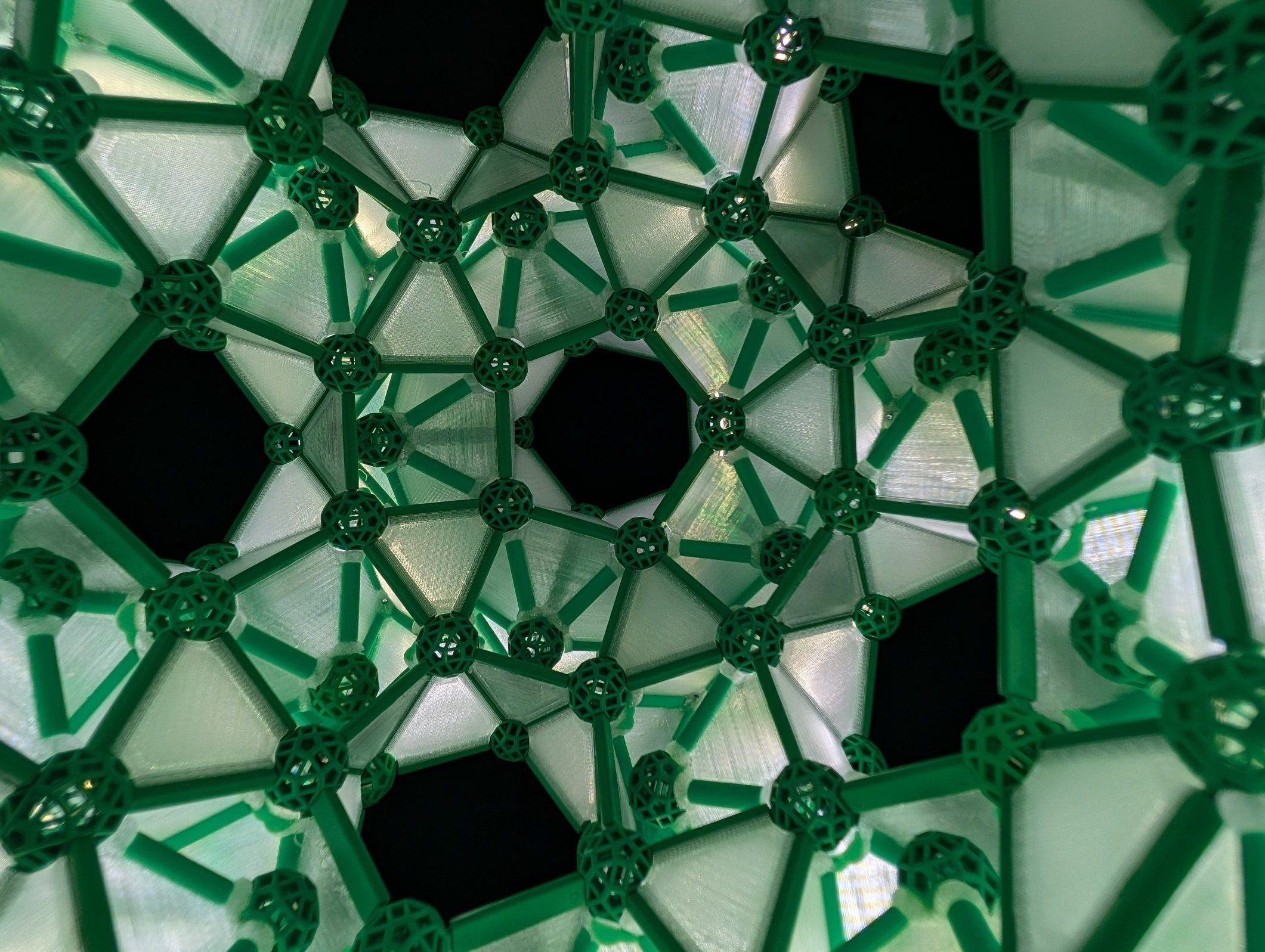
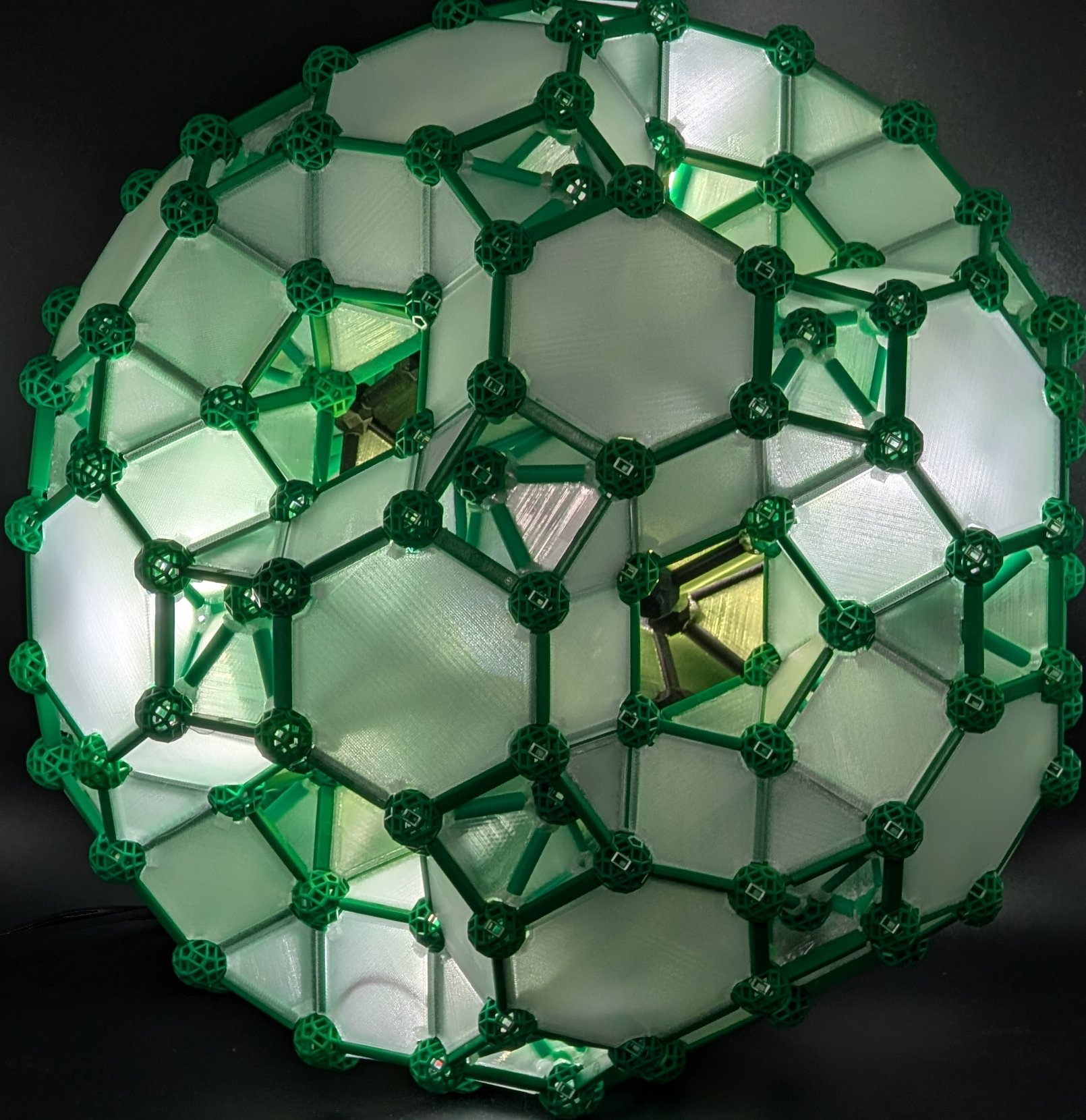
To make is easier to distinguish both composing parts, the panels and vertices of the Genus-41 toroid are coloured clear and green, whereas for the tunnels of the Drilled Rhombicosidodecahedron these are coloured olive green and black.
The Holey Monster has genus 46, which can be verified by:
genus = 1 + (#edges-#vertices-#faces)/2 → 1+(1482-458-934)/2 = 46
Compared to the Genus-41 Toroid, the solid body of the Holey Monster is augmented by six X-polyhedra and one cube. Two flight through's try to illustrate this. An external flight through jumps into a pentagonal hole, flies along two X-polyhedra, and finally emerges through another pentagonal hole. An internal flight through starts (part I) from within the solid body above a hole connecting to the central cube (under a hexagonal panel) and peeks around a bit into the neighbouring pathways. Next (part II) the camera jumps into the X-polyhedron, passes the cube and another X-polyhedron, before emerging (part III) under another hexagonal panel, where a final lookaround is made.
A final photograph shows a picture of the Holey Monster, only illuminated by LED strips put into the X-polyhedra of the solid body.